What’s Missing From the Chimp Rights Case: Chimp “Testimony”

22 04 2015

A new ruling by a judge in the New York Supreme Court has opened the way for legal arguments about whether chimpanzees should have “legal personhood.” To be clear, legal personhood doesn’t mean that chimps would be voting or having coffee at the local Starbuck’s, but that they would have the right to a fulfilling life in a humane environment, just as do people. (See this essay by Natalie Prosin for an excellent discussion of the issue.)

Nonhuman Rights Project logoAnd the ruling only ordered a hearing “to show cause,” not that the court was addressing the issue of whether the chimps had a right to a writ of habeas corpus.

The case brought by the Nonhuman Rights Project will be argued on both legal and scientific grounds. But I’m sure the hearing will not include “testimony” from the very creatures at the center of the controversy.

Obviously, I do not mean testimony in the sense of a chimp taking the stand, swearing on the Bible, and giving evidence. Rather, I believe that the case could be greatly informed by chimpanzees’ own spontaneous behavior—first-hand observations that go to the very heart of the case for legal personhood. I would argue that such behavior constitutes “testimony,” in that it portrays truths regarding chimpanzees that should be relevant in a court of law.

As examples, I offer my observations of chimp behavior during research for my novel Solomon’s Freedom, a fictional account of a court case seeking legal personhood for a chimpanzee. (Note: Steven Wise, president of the Nonhuman Rights Project, advised on the book.)

To research the novel, my wife Joni and I spent several weeks in The Ohio State University Chimpanzee Center, watching the chimps involved in numerical cognition research by psychologist Sally Boysen.

Negotiating a paycheck

In a typical research session, a chimp would take his (or her) place on a platform on the other side of a Plexiglas boysen5window from Sally or another researcher. In front of the chimp would be a touch screen, and Sally would present number problems requiring the chimp to pick the right answer by touching the screen. For a correct answer, the chimp would get a candy that Sally inserted through a small hole in the window.
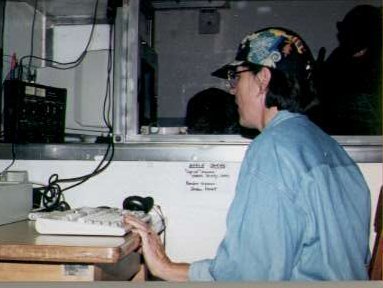
Working for a reward is not unusual in such studies. But what I thought was most telling was the “negotiation” that followed the research session.

At the end of the session would come a “payday,” in which Sally would take a paper bag over to a cabinet in sight of the chimp and proceed to put more goodies into the bag for the chimp. But the chimp was no chump. Sally would drop a few treats into the bag, and if the chimp didn’t think the pay was sufficient, he would give a decided negative shake of the head. So, Sally would add a few more goodies. Only when the chimp decided the “pay” was sufficient would he deem it acceptable with a nod of the head.

Browsing a magazine

Then there was the “magazine incident.” One day, I was standing near one of the chimps’ outdoor cages, and he emerged carrying a magazine. He proceeded to lie on his back, prop up one foot on his knee and leaf through the magazine, uttering appreciative grunts. Was he actually looking at a magazine, or only mimicking something he’d seen humans do?

Sally said that chimps did, indeed, like to look at the pictures in magazines, and did seem to recognize them as images of real objects.

In fact, Sally’s experiments demonstrated more rigorously that chimps can grasp abstractions. In one study, the researchers hid a toy Coke can in a model of the chimps’ playroom. They then released the chimp into the real playroom, and the chimp was, in many cases, able to immediately retrieve the Coke from its hiding place.

While most portrayals of chimps show them as violently screaming or passively munching food or lounging, we did see instances of the same kind of curiosity that humans display.

For example, one day Joni was planting flowers outside one of the outdoor cages, when a chimp approached, sat down and proceeded to quietly watch her at her work. She explained to the chimp what she was doing, and the chimp would periodically amble off and return to resume watching. After a while, Joni became intent on her gardening, no longer talking to the chimp. The chimp went away and shortly returned.

He then launched a mouthful of water across a distance of several feet into Joni’s face. Whether it was a demand for attention, a joke, or an aggressive act, it was clearly a strategic act of communication by a deliberative creature.

Getting darted

However, perhaps the most telling bit of “testimony” about chimp behavior relevant to legal personhood was the episode I witnessed of the chimp Bobby being tranquilized. Bobby had developed a cough, and the researchers wanted to make sure it wasn’t pneumonia. So, he had to be anesthetized with a tranquilizer dart gun, to be given a chest x-ray and health exam.

When Sally approached the cages with the dart gun, an enormous uproar rose among the chimps. According to Sally, it was the standard panicked response, because the chimps knew that one of them was about to be darted.

She approached a nervous Bobby and said, “Now, I’m going to have to dart you, so show me your rump.” It was important for Bobby to present his rump, so the dart would safely hit a fleshy part of his body.

Bobby complied, turning his rump toward Sally. She fired. The dart bounced off Bobby’s thick hide.

“Bring me the dart,” she instructed.

Bobby brought her the dart and once again turned his rump to her. She reloaded and fired again. This dart embedded itself into Bobby’s thigh.

“Now pull out the dart and bring it to me,” Sally instructed. Bobby obeyed.

“Now you’re going to go to sleep, so lay down,” she said. This command was important so that Bobby wouldn’t climb to a place where falling would injure him, Bobby laid down and was soon unconscious.

Such “testimony” revealing such evocative behaviors will not likely find its way into court proceedings to decide whether chimpanzees deserve legal personhood.

But it should.

(Notes: See this list of resources for further background on chimpanzee research and the case for legal personhood. Dr. Boysen’s laboratory was closed by the university in 2006.)




New Novel “Solomon’s Freedom” Dramatizes Chimp Rights Controversy

2 07 2014

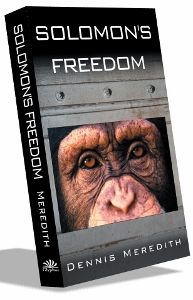
Should the life of a chimpanzee — particularly one taught to use language — be sacrificed to save a man’s life? That’s the provocative moral question posed by the new novel Solomon’s Freedom by Dennis Meredith.

In Solomon’s Freedom, flamboyant defense attorney Bobby Colter finds himself arguing for the life of a client Solomon's Freedom coverquite different from his usual string of miscreants. Solomon is a chimpanzee, and a unique ambassador for his species. He has been taught from infancy to express himself using a touch-screen computer. His educator and champion is Dr. Abigail Philips, a dedicated scientist who took over research on chimp intelligence after her primatologist father died.

But her laboratory is in financial peril, and billionaire media tycoon Walter Drake seems the ideal rescuer. He donates $10 million to the laboratory, in return for a seemingly innocuous stipulation. He asks for legal control of Solomon, promising to house the aging chimp comfortably in a spacious facility on his property, allowing Abby to continue her research.

That is, until Solomon’s life will be sacrificed to save Drake’s. He had an ulterior motive. Research that Drake funded on tissue engineering will enable his scientists to “harvest” Solomon’s heart to use its extracellular scaffolding to grow a new heart for the ailing mogul, from his own cells.

The success of the transplant would set a stunning precedent, encouraging the sacrifice of a thousand chimpanzees in sanctuaries for transplant donors. What’s more, Drake pledges to support preservation of wild chimpanzees and the breeding and “sustainable harvesting” of countless more for their organs.

The lawyer Colter, hired by animal rights advocate Sarah Huntington — a foe of Drake, but also his estranged mother — finds himself embroiled in the most controversial and challenging case of his career.

“Of course, I wanted to write a novel with engaging characters, surprising plot twists, and a dramatic climax,” says Meredith. “But I also wanted to write a book that explored the complex and emotional moral issues we face in deciding the fate of our closest living primate relatives.”

In researching Solomon’s Freedom, Meredith drew on chimpanzee studies by Jane Goodall, Sue Savage-Rumbaugh, and other researchers, and on the legal writings and advocacy by Steven M. Wise, a leading animal rights attorney. Wise and his group The Nonhuman Rights Project are currently engaged in court battles to attain “legal personhood” for chimpanzees. (Here is  a list of sources that inspired the novel.)

But the greatest influence on the novel arose from the time Meredith spent with the chimpanzees at Ohio State University’s Animal Care Center. Led by psychologist Sally Boysen, the research center was exploring the ability of chimpanzees to learn mathematical concepts.

“The experience profoundly inspired me,” says Meredith. “I’d done all this literature research on chimps, but that didn’t prepare me for the personal experience of hanging out with them — pun intended. Chimps display extraordinary intelligence in the wild, but more revelatory for me was seeing them deftly solve arithmetical problems and show other intelligent behaviors that could only be termed human-like.

“I remember sitting beside one of their outdoor cages and seeing a chimp emerge with a magazine. He proceeded to lie on his back, prop up his feet and flip through its pages, uttering contented grunts. Sally told me the chimps like to look at the pictures. Of course, he was still a chimp, so he later shredded the magazine for his bedding — a sensible step, I thought.”

Meredith also drew on the results of behavioral studies by Boysen and her colleagues that revealed the depths, and limits, of chimp intelligence. In one telling experiment, Boysen and her colleagues tested whether chimps who witnessed a miniature soda can being hidden in a model of a room could find the real soda can hidden in the actual room. Some of the chimps did find the hidden cans, showing that they possessed conceptual abilities related to language.

Unfortunately for Boysen’s research, fiction turned out to follow a sad reality. The university subsequently shut down her laboratory for financial reasons and sent the animals to sanctuaries. In honor of Boysen’s chimps, Meredith named the main human characters in his novel after them.

While the fictional Solomon is adept at using language, a major question that the novel raises is whether real chimps could possibly master language. There have been studies indicating that chimps can understand and use language concepts. One such chimpanzee was Washoe, who was taught American Sign Language by researchers Allen and Beatrix Gardner. In other prominent experiments, primatologist Sue Savage-Rumbaugh and colleagues taught the bonobo Kanzi and others to learn some language using keyboard lexigrams.

“However, there has never been a research project like the one described in Solomon’s Freedom, in which a chimpanzee has been intensively taught from infancy over decades to communicate using the rich medium of the touch screen,” says Meredith.

“And there is some evidence that chimpanzees, like humans, have a ‘critical period’ in infancy in which they could readily absorb language,” he says.

“So, I believe it entirely possible that if language-learning were begun early enough and with the right tool and enough time, chimps could exhibit substantial language abilities. However, given the cost and time involved, I doubt there ever will be such a study — which is a shame because of the scientific insights it would yield,” says Meredith.

Dennis Meredith brings to his novels an expertise in science from his career as a science communicator at leading research universities, including MIT, Caltech, Cornell, Duke, and the University of Wisconsin. His nonfiction books include Explaining Research (Oxford 2010), and his previous novels are The Rainbow Virus (Glyphus, 2013) and Wormholes (Glyphus, 2013).


The Hummingbird

21 07 2012

Sometimes we writers need to provide a respite from our all-too-tumultuous, sometimes-tragic world. In a departure from this blog’s usual topic, here’s a little story from the mountains of North Carolina:

I first saw the hummingbird as I was moving furniture on the screened porch. He was a bedraggled clump of feathers no larger than a cotton ball, slumped on the floor, wings spread. He had clearly been trapped in the porch after having flown in the open door, and had worn himself out flying against the screen. I felt responsible because the day before, I’d left the door open while cleaning. It was a sad irony that the little bird had flown thousands of miles from Central America on his migration, only to die on a screened porch in North Carolina.

Since I thought he was dead, I scooped him up to carry him outside. But somehow he didn’t feel dead in my hand. He moved slightly, and began to give out occasional faint cheeps. He was still alive! But he was limp, and his feathers were tattered from thrashing against the screen. I also knew he was dying because during summer hummingbirds only store enough energy to survive overnight, and this one had likely been in the porch for much longer, wearing himself out futilely trying to escape.

I thought he might have a chance to survive if I set him on a feeder. So I brought him upstairs and tried to position him with his claws gripping a perch and his beak inserted into the plastic flower. So all he had to do was extend his tongue to feed. It wasn’t easy getting him positioned because he weighed almost nothing and was so tiny. I dropped him several times, and as he hit the floor, I hoped I hadn’t injured him further.

I finally maneuvered him into a stable position and left him to go inside and get the camera. But when I looked through the window, I saw that he had somehow dislodged himself and was hanging upside down from the perch, clinging to it with a single claw. I repositioned him several times, only to see him work loose, but still hang on to the perch, literally for dear life. I had to do something else.

He needed to be in a position to feed without having to grip a perch. So I placed him on the porch railing and found a pink milk bottle top, filled it with nectar, and held it against his beak. Maybe the pink color would induce him to feed. Then, to give him more elevation, I placed him on a jar top so he could feed downward at a natural angle.

All the time, I was buzzed by the cloud of dozens of impatient hummingbirds who come to the feeders. One even swooped down to investigate the bottle top, hovering by my hand as I tried to get the little hummingbird to feed. Bees and wasps also buzzed me, but I held my ground. I realized my other hand was cramping because I was unconsciously gripping the porch post so hard.

The hummingbird still didn’t respond. His breathing was indiscernible, and only an occasional slight movement told me he was still alive. I persisted, keeping his beak in contact with the nectar. Then after fifteen minutes or so, he opened his beak slightly. He’d tasted the nectar! I waited, keeping his beak in the liquid. He began to open his beak more often.

Then I saw a subtle telltale movement in the nectar. He’d begun to flick out a tiny translucent tongue slimmer than a thread. Over the next minutes, his feeding grew more frequent, the tongue extending farther into the nectar. I could tell his breathing was growing stronger, because the iridescent green feathers on his back began to rapidly rise and fall. He moved his head slightly, another sign he was reviving. Since he was gaining strength, I took the chance to shoot a photo, holding the camera in one hand and the bottle cap in the other.

I continued to feed him, determined to stay until he either revived enough to test his wings, or finally died. I bent down to see whether his eyes were open, but they remained closed. Maybe he had been too far gone after all. The bottle cap needed more nectar, so I turned away to get the nectar jar.

And whoosh! He was gone! I caught only a glimpse of a feathered streak sailing away into the distance.


A Champion of Engineering Makes an Eloquent Case

14 05 2010

Engineer/Author Henry Petroski, in more than a dozen books, has taken readers on engrossing adventures into subjects ranging from the pencil to collapsing bridges. In his latest book, The Essential Engineer: Why Science The Essential EngineerAlone Will Not Solve Our Global Problems, Petroski eloquently challenges a fundamental and profound bias in our society—the relegation of engineers and engineering to second-class status among professions.

Even though every manmade object—including the computer on which you read this review—was invented by engineers, they remain all-but-invisible in the media and in the public conscious. For example, an analysis by researchers Deborah Illman and Fiona Clark of two decades of research coverage in The New York Times found that mentions of science and scientists consistently outnumbered by two to one mentions of engineers and engineering.

In The Essential Engineer, Petroski traces the roots of the perceived primacy of science over engineering, declaring that

…our Western Platonic bias has it that ideas are superior and prerequisite to things. Hence, scientists who deal in ideas, even ideas about things, tend to be viewed as superior to engineers who deal directly in things. This point of view has no doubt contributed to the mistaken conclusion that science must precede engineering in the creative process.

In America, the origins of the science-before-engineering bias arose in the 1940s, when science administrator Vannevar Bush promulgated a simplistic linear model of science and engineering “that put research before development in name, status, fact, and deed.”

Petroski demonstrates the fallacy of this model by pointing out that technologies including the steam engine, powered flight and rockets “provide incontrovertible evidence for technology leading science. Basic research, in short, has long been suggested and motivated by and intertwined with technological development–and often has been led by it.”

In short, he writes, R&D could just as well be D&R, and “both R&D and D&R are really linked segments of a long and continuing line of interdependent activities and results. Perhaps we should speak of R&D&R, or even longer strings of D’s and R’s, as if they were part of an industrial genome.”

“Science is a tool of engineering,” writes Petroski, “and as no one claims that the chisel creates the sculpture, so no one should claim that science makes the rocket. Relying on nothing but scientific knowledge to produce an engineering solution is to invite frustration at best and failure at worst.”

What’s more, he writes,”…engineering and technology often precede science, because so many instruments and devices are needed to carry out the experiments essential to making scientific observations and testing scientific hypotheses.”

The media in general, and not just The New York Times, have done their part to minimize the importance of engineers, writes Petroski who suggests that “…as a way of dismissing their individuality…that engineers are often subsumed by careless journalists and layperson into the general rubric of scientist.”

Petroski also addresses the interchangeable use of “engineers” and “scientists” in newspaper headlines, asking “…could it be promulgated—if unwittingly—by science writers and reporters in the media whose members have overwhelmingly studied science rather than engineering in college?”

One problem, points out Petroski, is that too many of engineering’s accomplishments are “underground, behind architectural facades and associated with other professions.” Another problem is that when engineers are placed front and center in media coverage, it too often tends to be in the context of disaster.

The Essential Engineer is far from a negative screed, though. Petroski deftly describes the optimistic, challenging, rewarding nature of engineering, declaring that “The design of engineering structures is a creative process in the same way that paintings and novels are the product of creative minds. ” He writes that

Scientists also warn us of the entropic disasters associated with climate change, asteroid strikes, and the like, but warnings are not solutionsnor are they necessarily a death knell. It will be the optimistic engineers who hear the warnings not as doomsday scenarios but as calls to tackle significant problems.

And as for the complexity of engineering’s challenges, Petroski emphasizes that the profession entails more than a rote designing of widgets:

The engineering of things is “pervaded by choice,” something that cannot be easily said about science or even engineering science, to which the natural and made world are givens. Whatever scientists may wish, they cannot credibly propose a theory of motion that does not comport with the facts of the universe.

In a declaration that might surprise many unfamiliar with engineering, Petroski cites its connection with humanities, declaring that “… it behooves scientists and engineers to be connected with the cultures of the humanities and social sciences. Solutions to global problems must take into account matters of humanity and society…. The goal, after all, is not science and engineering for their own sake, but for the sake of the planet and its inhabitants.”

To demonstrate the richness of engineering, Petroski takes the reader through a tour of technologies as seen through the eyes of an engineer, including speed bumps and humps, dams, climate change, “geoengineering” of the earth to combat climate change, renewable energy, nanotechnology, robotics, structural earthquake engineering, hurricane protection, airline accidents, the electric power grid, evolution of the automobile, and “financial engineering.”

And, he firmly establishes engineering’s place in solving the daunting problems such as climate change and energy shortage, facing humanity, writing “In the final analysis, it will be engineering that possesses the same qualities involved in accomplishing the great achievements of the last century that will be the key ingredient in a solution.”

The Essential Engineer—an accessible, enjoyable tour of engineering—is essential reading, not only for engineers and students, but for all of us who benefit from the vast wealth of technology that makes modern life possible.