Tips on Teaching Tykes (and Grownups, Too)

13 02 2010

My daughter, Dr. Wendy Hunter, a pediatrician, gave a talk at my granddaughter’s elementary school this week, and

Dr. Wendy Hunter

Dr. Wendy tells a second grade class fascinating tales of bones

the presentation reminded me of some good principles for giving successful presentations for kids. In fact, since adults are just grown-up kids, these principles could also make your talks at the local civic club or college class more successful:

  • Bring your energy. Enthusiasm is contagious, and if you show your own enthusiasm for your subject, the audience will catch it. You might be used to low-keying your scientific talks, but being restrained for a public talk lowers audience interest. Dr. Wendy’s animation and energy helped grab and hold the kids’ interest.
  • Bring interesting props. Dr. Wendy found an accurate model skeleton at Carolina Biological Supply that was the perfect demonstration for bones, how they fit together, and how they can break.
  • Give the audience a job. She passed out plastic skeleton kits for the students to assemble as she talked about the various bones and how they fit together. Doing while they were hearing helped the kids remember the lessons.
  • Bring “real” things. Dr. Wendy showed cross-sectioned cow bones to give the kids a chance to see and touch real bone marrow, memorably showing them where blood cells are made.
  • Personalize your presentation. For example, using a volunteer, Dr. Wendy showed how the kneecap “floats.” She also explained how it can be knocked out of joint, and how it can be repositioned.
  • Give useful tips. She explained how people fracture their forearms by “foosh”– falling on outstretched hand–and how people can avoid that fate by bending their arms to catch themselves if they should fall forward.
  • Give the audience a mystery to solve. She passed out x-rays of various bone breaks and dislocations and challenged the kids to identify the part of the skeleton shown and the abnormality.
  • Learning can be loud. The sound of learning in kids can be cacophonous. It’s hard for presenters used to respectftul silence in their adult audiences to remember that fact. Dr. Wendy’s class reverberated with excited chatter as the kids assembled their skeletons, crawled around looking for a lost (model) foot, and poked around on themselves looking for various bones.

So, heed these tips for both your young and adult audiences, and they will, indeed, feel your presentation in their bones.


Scientists are Heroes

12 02 2010

(Here’s the latest round in my campaign to convince scientists and engineers that the public sees them as respected heroes. This article appeared on The Scientist Web site, February 12, 2010. Free registration required)

The author of a new book contravenes the myth that the public views scientists as geeks or villains.

by Dennis Meredith

For me, the last straw came several years ago when the director of a major national laboratory declared to an audience of reporters at a large scientific meeting that the public sees scientists as geeky, unattractive, or “mad.” He wasn’t the first scientist to spout this corrosive myth about his own profession. But I hope that the clear evidence to the contrary in my book Explaining Research will make him the last.

In fact, I think that the public overwhelmingly sees scientists as heroes. This is demonstrated most convincingly in the positive portrayal of scientists in movies and TV shows, which are prime barometers of public perception.

Opinion polls also bear out the public’s perception of scientist-hero. In a 2006 Harris Poll, for example, Americans said they trusted doctors (85 percent), teachers (83 percent), scientists (77 percent) and professors (75 percent) far more than they did journalists (39 percent), lawyers (27 percent), or pollsters (34 percent). And respondents to a 2009 survey by the Pew Research Center for People and the Press said that people who contributed the most to society’s well-being were members of the military, teachers, scientists, medical doctors, and engineers. The major survey Science and Engineering Indicators 2008, by the National Science Board concluded that “more Americans expressed a ‘great deal’ of confidence in leaders of the scientific community than in the leaders of any other institution except the military.”

However, the most dramatic insight into public perceptions of scientists comes from their depiction in movies and TV shows. After all, Hollywood tends to follow popular opinion when casting its heroes and villains. It seems to me that criminals, terrorists and greedy businessmen are the most frequent villains, and scientists among the most prevalent heroes. For example, in Jurassic Park, the heroes were paleontologist Alan Grant, paleobotanist Ellie Sattler, and mathematician Ian Malcolm. The villain was foolish entrepreneur John Hammond.

In Explaining Research, I decided to confirm this notion by presenting statistics on Hollywood’s portrayal of scientists. I compiled a list of some 140 films depicting scientists and engineers—drawing on the filmography in Sidney Perkowitz’s book Hollywood Science and also searching the Internet Movie Database. I then judged whether the scientists in those movies were heroes or villains. The analysis revealed about six times more scientist-heroes than scientist-villains. (For complete movie lists and discussion see “Scientist heroes” on the Explaining Research Web site.

Actually, the list of truly villainous scientists is even smaller because of a key caveat: most of the putative scientist-villains were not really evil, but merely flawed—either misguided or overly ambitious—or suffered when their research escaped their control. For example, in Spider-Man 2, the virtuous Dr. Otto Octavius transformed into the villainous “Doc Ock” when he was taken over by the mechanical tentacles he had developed as artificially intelligent tools. And in the end, it was Octavius, and not Spider-Man who saved the day by sinking the uncontrolled fusion ball into the sea.

Movie biologists have saved the earth—or at least a significant chunk of it—numerous times. For example, the scientists in the Andromeda Strain and Outbreak, rescued humanity from catastrophic infectious disease outbreaks through cutting edge science and a healthy dose of luck. They’ve even fought to save alien planets, as did Dr. Grace Augustine (Sigourney Weaver) for the verdant Pandora in James Cameron’s latest blockbuster Avatar.

Some of Hollywood’s biggest stars have portrayed scientist-heroes, including Ben Affleck, Jessica Alba, Nicolas Cage, Russell Crowe, Laura Dern, Robert Downey Jr., Harrison Ford, Cary Grant, Anthony Hopkins, Dustin Hoffman, Angelina Jolie, Eddie Murphy, Bill Murray, Liam Neeson, Edward Norton, Gwyneth Paltrow, Bill Paxton, and Will Smith. Would those A-list actors sign on to play scientists if researchers were really considered geeks, devoid of personality?

Scientists are also equally heroic on TV these days. The bane of countless fictional criminals are the scientist-heroes of Bones, CSI (Las Vegas, New York, and Miami), Criminal Minds, NCIS, Numb3rs, and other popular crime dramas.

My aim in demonstrating that the public sees scientists as heroes is not just to boost scientists’ self-esteem, although that’s certainly important. I also hope that the next time a scientist stands before an audience to advocate for adequate research funding, argue for policies to alleviate global warming, or debate creationists, he or she will do so confident in having the considerable advantage of being seen as a trusted, credible, hero.




Toyota Recall: You Can’t Fix Stupid

3 02 2010

Regardless of whether Toyota finds and fixes the flaws in their cars that cause uncontrolled acceleration and faulty braking, their mismanagement of communications has been an unmitigated disaster that alone will cost them huge financial losses and a severely damaged reputation. Or, as the old saying goes, “You can’t fix stupid.” Reuters has published one good account of Toyota’s PR problems.

Perhaps the only slightly silver lining in this dark cloud is that Toyota’s blunders offer useful communication lessons for anybody facing a crisis. Some examples:

  • Toyota took far too long to respond publicly to the problem. Its CEO did not comment for months after the problem started and has only responded informally. A smart communications plan would have had him speaking on YouTube and at news conferences from the time the crisis first began.
  • Toyota should have offered clear steps its customers could take to protect themselves.  In an article in the Fort Myers News Press, public relations expert Tina Matte pointed out that the company didn’t tell consumers what they should do about driving vehicles with the flaws.
  • Toyota was far from transparent. The company  only gave the public vague reassurances that it was developing a solution, and it hid the process behind the usual corporate wall of silence. A far more effective, albeit daring, approach would have been to put the company engineers out front, discussing candidly what they knew and didn’t know about the problem as they were working on it. Such candidness would serve  not only to reassure the public, but to portray Toyota sympathetically as an open organization, deeply concerned about the quality of its products. Perhaps public discussion might have even brought useful insights from the vast legions of engineers who would have avidly followed the developments.
  • Toyota used 20th-century communication methods. For example, full-page newspaper ads are woefully outdated. And when it did use social media, it did so ineffectively. In the News-Press article, public relations expert Ginny Cooper pointed out that the company’s Facebook page merely redirects readers to the recall Web page on Toyota’s main site. Cooper recommended a separate tab on the Facebook site addressing the recall. And, she said, there should be a separate Web site for the recall.
  • Finally, and perhaps most importantly, Toyota should have apologized early and often. Not only were apologies slow to come, but PR consultant Msato Takahashi pointed out in the Reuters article that the first apology by a headquarters executive did not include a deep bow, a standard gesture in Japan when a firm admits responsibility for a mistake. (Update: CEO Akio Toyoda finally issued a formal apology, complete with bow, on February 5, 2010, in his first formal remarks about the problems). Corporate lawyers often advise against such public apologies, arguing that they establish fault and weakens a company’s position in lawsuits. However, lawyers don’t take into account the full business impact of apologies. I suspect that early, frequent, heartfelt apologies would have been far more financially beneficial to Toyota–both in reducing lawsuits and in maintaining reputation.Certainly, the medical profession has found that apologies reduce malpractice suits.

It will be fascinating to watch how Toyota continues to handle their crisis communications, and whether their reputation recovers. For more tips on handling a communication crisis, see this tipsheet on the Explaining Research site.


Funny Engineering Conversions!

1 02 2010

Yes, Virginia, engineering conversions can be funny! A friend sent me this collection from crosswalk.com. A few of my favorites:

  • Ratio of an igloo’s circumference to its diameter? Eskimo Pi
  • 2,000 pounds of Chinese soup? Won Ton
  • Half of a large intestine? 1 semicolon
  • 2,000 mockingbirds? 2 kilomockingbirds
  • 10 cards? 1 decacards
  • 1 kilogram of falling figs? 1 Fig Newton
  • 1 millionth of a fish? 1 microfiche

Slip a couple of these into your next talk and give your audience a giggle.


Evolution of Explaining Research: Lessons for Authors

31 01 2010

(If you’re considering writing a popular science book, my experiences in bringing Explaining Research to publication might be helpful. Here’s an article I wrote on the process for ScienceWriters, the magazine of the National Association of Science Writers. Below is the introduction, followed by a link to the full article:)

Explaining Research (Oxford University Press, 2010), began its eccentric evolution as a modest booklet-sized manuscript that I planned to self-publish; but ended up as a 368-page book produced by a major academic publisher. The tale of that evolution, I think, offers useful lessons for authors who face a daunting new era of self-publishing technology and an economically depressed publishing industry. (Read the article)


Snagit: a Great Tool for Screen Captures

30 01 2010

If you’ve done screen captures like I’ve done in the past, you probably just hit the “Print Screen” button (PrtScrn) to copy the whole screen to your clipboard, then inserted it into your presentation or document. Or, maybe you used the simple snipping tool in Windows Vista and Windows 7.

But now that I’ve discovered Snagit that’s all changed. It’s an incredibly useful piece of software for selectively lifting  all or part of a Web page or other screen segment and sending it to Excel, Word, PowerPoint, e-mail, or just about any other program. You  can capture images, text, screen video and even a Web page, complete with active links. In fact, I usedSnagit home page graphic Snagit to capture the image of the Snagit home page graphic on this post. You can even record animated sequences of interactions with a Web page, showing cursor movement and the effects of clicking on links.

When I created a recent PowerPoint presentation, I used Snagit to record such an interaction, as well as capturing and editing logos, selective chunks of Web page and other visuals to make my PowerPoint presentation look much more professional. You can also add arrows, speech bubbles, labels and other explanatory elements to the captured images. And if you want to emphasize a particular section of a Web page, you can even blur out the whole Web page except for that section.

Try the free 30-day trial. I can just about guarantee you’ll end up buying it. At $49.95, it’s a bargain. I should add that there are other screen capture programs out there, including  CaptureXT, CaptureWizProFastStone, and !Quick Screen Capture. They may work well, too, but I chose Snagit because it received the best reviews.


Create Screensavers to Show off Your Visuals

25 11 2009

It dawned on me that I forgot to include in the book a terrific use for research images: in screensavers. Not only will a screensaver show off your images and video on your own computers, but your audiences can download it to run on their machines. If you have a Windows computer, you can create a simple screensaver on your own machines  using the Personalize feature. Just right click on the desktop, click on Personalize, choose the Screen Saver option, and choose the Photos option for your screensaver. You can then designate which photos to use.

Of course, this method creates only a basic slide show, and you can’t offer it for download. You can produce more elaborate downloadable screensavers using such commercial software as Screensaver Factory, Screensaver Maker, Screentime, Ultra Screen Saver Maker, or iEasy Screensaver Station. There are many more programs out there. Just do a Google search for “screensaver software” or check out CNet’s screensaver listings to find one that fits your needs.

These software packages enable you to create screensavers using images, video, and Flash animations, and even add interactivity. Some of the more advanced software might be complicated to use, however, so you might want to enlist or dragoon a programmer to produce more elaborate screensavers.

Your screensavers can use not only your own images and videos, but those from other sources, with appropriate permission and credit, of course. For example, an astronomy screensaver could use Hubble telescope images of the objects you study; or a structural engineering screensaver could show examples of the bridges that illustrate the principles behind your work. Think visually!

Even simpler than screensavers are wallpaper images. For example, National Geographic offers a huge collection of its elegant images as wallpaper. Like them, you would have to offer your images in two sizes–800×600 pixels for smaller monitors and 1024×768 pixels for medium-sized monitors. National Geographic also offers larger images of entrants in its photo competition as wallpaper.

When creating your screensavers or wallpaper images, don’t forget your communication “strategy of synergy.” That is, include in the images the URL of your lab or center, as well as other information that could induce your audiences to explore your research.


“Am I Making Myself Clear?” Absolutely!

12 10 2009

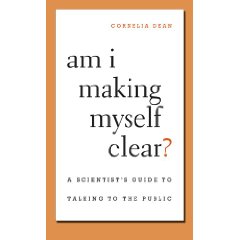
Cornelia Dean’s new book Am I Making Myself Clear?: a Scientist’s Guide to Talking to the Public does a great serviceamimakingmyselfclear to scientists, as well as journalists and the public. For one thing, it offers a concise guide for scientists to public communication from one of the country’s most distinguished science writer-editors. Dean brings to the book her extensive experience at arguably the world’s premier newspaper for science coverage, The New York Times.

Dean makes a compelling case for scientists’ involvement in public issues, declaring that “if they participated more in the public life of our nation, if they dropped their institutional reticence and let their voices be heard beyond realms of scholarly publication, they could … inject a lot of rationality into our public debates.”

Her chapters on the nature of the news business and the worsening state of science journalism not only help scientists understand what is an alien realm to most of them. Dean also offers a valuable inside look at the thinking process of a professional communicator wrestling with how to responsibly communicate hot-button scientific issues. For example, she writes how she developed a concise statement on the issue of evolution: “I eventually worked out the wording that allows me to sum up the situation, I believe accurately: there is no credible scientific challenge to the theory of evolution as an explanation for the complexity and diversity of life on earth. I use this language often when I write about evolution. But I am criticized for it. On some Web sites, creationists call it ‘Cornelia’s Creed.’”

The book also offers a wealth of insightful journalists’ tips on working with an editor, interviewing subjects, writing op eds, crafting letters to the editor, working with editorial boards, and writing accessibly about science. My favorite writing tip: “when writing in English, a language derived from German, strive to use words with German roots in preference to words with Latinate roots. Talk about cats not felines, or water that is safe to drink rather than potable. Don’t inhale and respond, take a breath and answer.” Also valuable is her perspective on how to effectively and responsibly work with public relations people to disseminate news of one’s research findings.

Her chapter covering the bumpy road from print to online journalism offers readers a cautionary road map charting the hazards, warning that

online journalism is developing standards that differ, sometimes wildly, from what some journalism scholars call “the discipline of verification,” a hallmark of the mainstream media. That discipline can give way to a “journalism of assertion” in which people post, often anonymously, erroneous, defamatory, vulgar, or mindless observations that would rarely, if ever, gain attention at a respectable news outlet.

And for those scientists contemplating writing a popular book, Dean offers the pithiest piece of advice I’ve ever encountered on the subject: “Don’t think about writing a book unless you really cannot help yourself.” If, indeed, you cannot help yourself, Dean’s guidance on navigating the publishing world and working with a collaborator are invaluable.

No scientist should consider plunging into the messy arenas of the courtroom or Congress—testifying as an expert in court, or before a congressional committee—without reading Dean’s chapters on those subjects. Her clear explanations of the pitfalls and techniques in such endeavors will no doubt rescue many scientists from missteps and make them far more effective.

It is fortunate that the publishers decided to make the book’s cover a distinctive orange, so that it will be easily locatable on the great many scientists’ bookshelves where it deserves to reside.


“Dueling” Monkey Robot Videos Offer a Lesson in Communicating Research

8 10 2009

It’s rare that I get a chance to show vividly how  an ill-advised media policy can compromise communication of a piece of research. But two videos about development of brain-machine interfaces enable me to do just that. One video, below,  covers a story about Duke University neurobiologists using the brain activity of a monkey to control real-time walking patterns in a robot in Japan.

And a second video covers a story about University of Pittsburgh researchers using a monkey’s brain signals to control a robot arm, to enable the monkey to feed itself.

As you watch these videos, judge which one you think most effectively portrays the research and why. And guess which video received the most media play. (Although the research advances were both reported in 2008, I’ve just had a chance to do the analysis of their coverage.)

Both the Duke and the Pittsburgh research efforts are certainly important and newsworthy. But I think it’s fair to say that the Duke achievement–given the complexity of the walking behavior involved–is the greater of the two.

However, because Duke’s media policy severely limited what its video could portray, its research received far less media attention than the Pittsburgh story. Duke strictly prohibits any photos or videos depicting the use of animals in research, even if those images are central to the story. Thus, the Duke video could only feature an animation of the monkey on the treadmill, and not footage of the actual experiment. Not only was the animation primitive, but it was factually misleading. The “monkey” is anatomically inaccurate, looking more chimpanzee-like than rhesus-like. And the animation shows no evidence of electrodes attached to the monkey, leaving viewers to wonder how the signals got from the monkey’s brain to the robot.

In sharp contrast, the Pittsburgh video shows dramatic footage of the real monkey operating the robot arm to feed itself. The researchers cleverly  avoided complaints from animal rightists by obscuring the brain electrodes behind a piece of equipment. Also, it’s clear from the monkey’s behavior that it is perfectly comfortable.

Duke’s use of animation was also counterproductive in that it raised the most doubts in viewers, with one viewer commenting “This looks like BS. I’m not saying that it is, but the monkey isn’t real, the robotics footage is looped and shows feet never making solid contact with the ground, this may as well be fake as the stupid monkey.”

So, which video received the most coverage? Pittsburgh’s by far. Besides being featured on network news shows, it was posted on Web sites including BBC, PBS Online NewsHourNPR’s Science Friday, and Reuters. A subsequent video was also featured on the National Geographic Web site.  By contrast, the Duke footage showed up only on Reuters.

The New York Times did use videos in its Web coverage of both the Duke story and the Pittsburgh story, but the latter online story was made much more compelling by inclusion of its accompanying video.

But does it really matter that Pittsburgh’s research received more media attention than Duke’s? Yes, it does, given that media coverage reaches a wide range of key decision-makers, from donors to funding agency administrators, to legislators. And it matters because such media coverage also reaches prospective collaborators and other important scientific constituencies. Finally, increased media coverage influences scientific citations, as I discuss in the introduction to Explaining Research.

Duke’s refusal to depict animal research also has a broader moral and ethical dimension. In doing so, the university is evading its responsibility as a major research institution to emphasize the importance of animal research to medical advance—ironically aiding the cause of animal rights groups that oppose such research.

As an aside, an informal poll I did of major research universities found a broad spectrum of policies on depicting animals in research; but Duke was very much at the extreme end of that spectrum in its outright prohibition.

The broad lesson, I think, to be drawn from this case is that administrators need to get beyond their own expediency—perhaps even timidity—in setting communication policy. They should consider their broader responsibilities to their institution, its researchers, and science as a whole.


How Caveats Evaporate: Facebook Study Offers a Cautionary Tale

22 08 2009

Ohio State research communicator Earle Holland has written an insightful account in the online Columbia Journalism Review recounting media misrepresentation of a pilot study by an OSU graduate student that showed a link between Facebook usage and lower grades.

The basic problem was that, while the study found only a correlation between the two, The Sunday Times of London published a story declaring a causative link, saying that “the website is damaging students’ academic performance.” This erroneous report set the tone for much subsequent inaccurate coverage.

OSU did everything right in issuing the news release. It quotes the researcher up front saying that “We can’t say that use of Facebook leads to lower grades and less studying–but we did find a relationship.”

And further down in the news release: “There may be other factors involved, such as personality traits, that link Facebook use and lower grades,” she said. . . . “It may be that if it wasn’t for Facebook, some students would still find other ways to avoid studying, and would still get lower grades.  But perhaps the lower GPAs could actually be because students are spending too much time socializing online.”

While the reporters who confused correlation and causation are the obvious culprits in the miscommunication, some people criticized the university news office for issuing a news release on such a preliminary study. But that criticism misses an important point: that the poster session was at a meeting of a major scientific society. And since the study was on a hot topic–social media–it was likely to be noticed by reporters and stories written anyway.

So, the most responsible course of action by the news office was to prepare a carefully written news release that got the facts straight, put them in context, and protected the researcher against claims of misrepresentation.

One clear lesson here is that when in doubt, the best course is to produce a news release on a piece of research that clearly explains the findings and spells out caveats. A second lesson is to assume that those caveats may well be ignored, so you and your public information officer should carefully monitor coverage to respond to inaccuracies.